Blog › Journaling
Does journaling actually work?You will know by week nine.
Journals, mood trackers, workbooks, habit trackers, meditation, coaching, therapy. What each one asks of you, and what you get back for it.
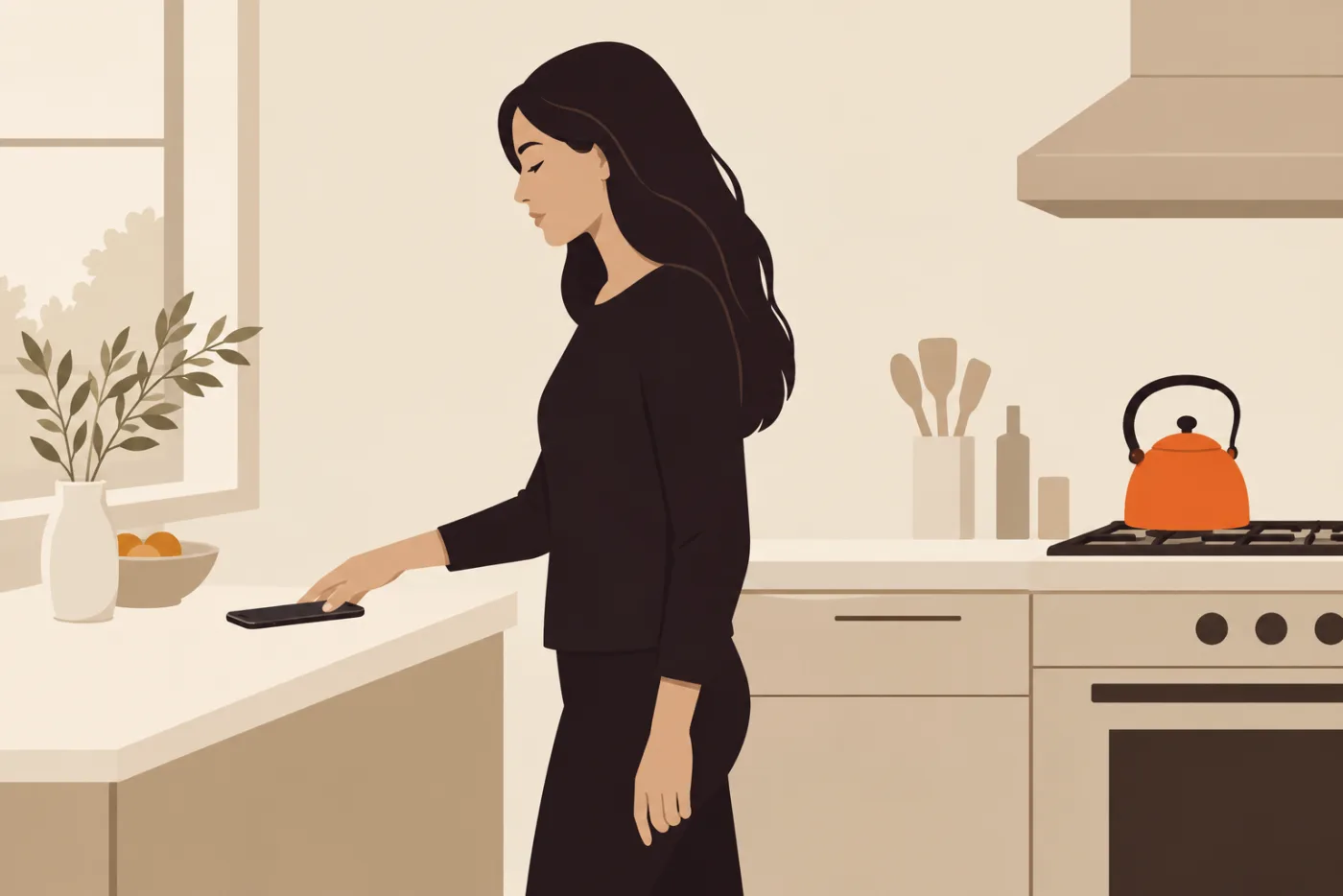

If you only keep one, keep the one you will open tomorrow.
Every option below works for somebody. The ones that fail fail the same way: they ask for more than you have on a Tuesday. Pick for the size of the daily ask, not for the size of the promise.
The question in the title has a real answer, and it is not the one either side of the argument wants. Writing works. Expressive writing has thirty years of trials behind it and the effect is small but real. What decides whether it works for you is whether the thing is still open on a Tuesday in week nine, after the novelty has gone and the day was long.
That is the axis nobody compares on, so this page compares on it.
What each one asks, and gives
Seven formats, on the two things that decide whether you keep going: what it wants from you on an ordinary day, and what it hands back.
| Asks of you | A day | Gives back | Treatment | |
|---|---|---|---|---|
| glissa | Taps, never a page | 30 seconds | A number that moves, one dare a week | No |
| Journal apps | A blank page and the words | 10 to 20 minutes | Whatever you wrote, if you reread it | No |
| Mood trackers | A tap on how you felt | 10 seconds | A chart of your moods | No |
| CBT workbooks | Reading, then written exercises | 20 to 40 minutes | A method you can use on any thought | Sometimes, with a clinician |
| Habit trackers | A habit you already chose | A few seconds | A streak, and the count | No |
| Meditation apps | Sitting still and attention | 10 to 20 minutes | Practice at not following a thought | No |
| Therapy | An hour, and the talking | An hour a week | Someone who knows your history | Yes |
Coaching sits between the last two rows: an hour a fortnight, a plan, and somebody expecting it done. It is unregulated and the quality range is enormous, so ask what happens in week six before you pay for week one.
Where each one wins
-
If your thinking untangles on the page
A journal is the right answer and nothing here beats it. You find out what you think by writing it, and the prompts in a shadow work journal go at the parts you avoid.
-
When you want a method you keep
A CBT workbook. Most evidence behind it, most work to finish. Catch a thought, write it, test it, answer it. Finish one and you own the skill.
-
Whether any of it actually moved
Something that asks the same questions every week. Feelings make a poor instrument for measuring feelings, which is the gap ours was built for.




Almost everyone stops in the first fortnight
The size of the daily ask decides this, more than any feature list does. An app you open twice is worth less than a duller one you open in week nine, and almost every comparison of these tools ignores that entirely.
Retention across mental health apps: Baumel and colleagues, JMIR, 2019. On writing and health: BMJ, 2002.Seven in ten opened it the day they downloaded it. Two weeks later it was under four. Nothing in that fall is about which app had the better feature list, and every comparison you will read is written as though it were.
The four apps you get named when you ask
Ask ChatGPT or Google for an app for people pleasing and four names come back. One of them is ours, so every other row carries what it does better than us.
| Best at | Price | Where | |
|---|---|---|---|
| glissa | Putting a number on how much of you is showing, and moving it | $4.99 a month, billed as $59.99 a year or $7.99 a week | iPhone |
| Bounds | Handing you the sentence while the request is still open | $14.99 a month, $34.99 or $79.99 a year, or $149 once | iPhone and Android |
| I Can Say No | Being free, offline, and in 44 languages | Free with ads, $3.99 to $27.99 in app | iPhone |
| Wysa | Being there at three in the morning, without signing up | Free to talk, $9.99 a month for more | iPhone and Android |
If the problem is the ninety seconds after someone asks and your mouth is empty, Bounds is the one to try, and it runs on Android. To pay nothing, I Can Say No works with the plane mode on. If the hard part is late and alone, Wysa answers.
Lose the habit. Become magnetic.
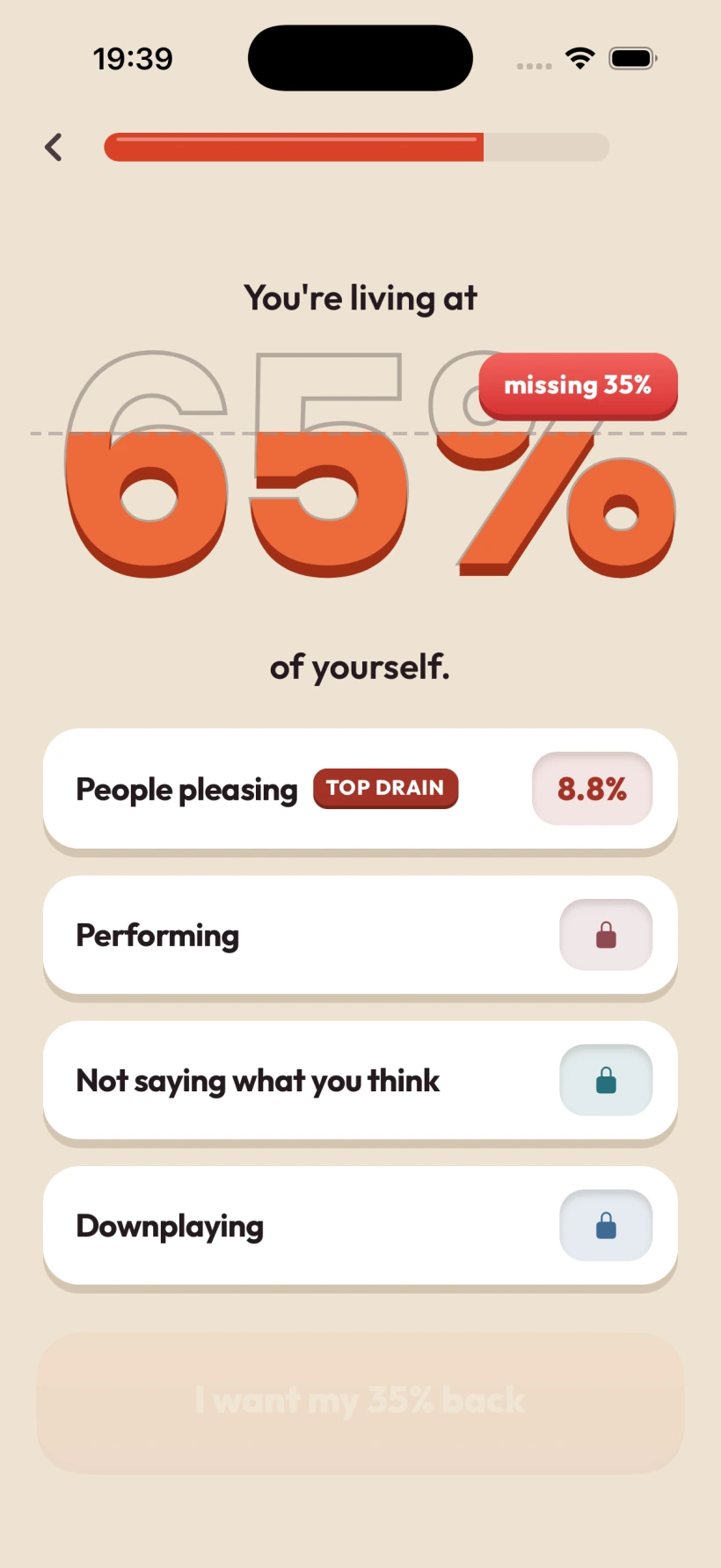
Get back the parts of you that you filed down to keep everyone else comfortable. One small dare a week, and a number that goes up.
Download Glissa for iPhone $4.99 a month, billed as $59.99 a year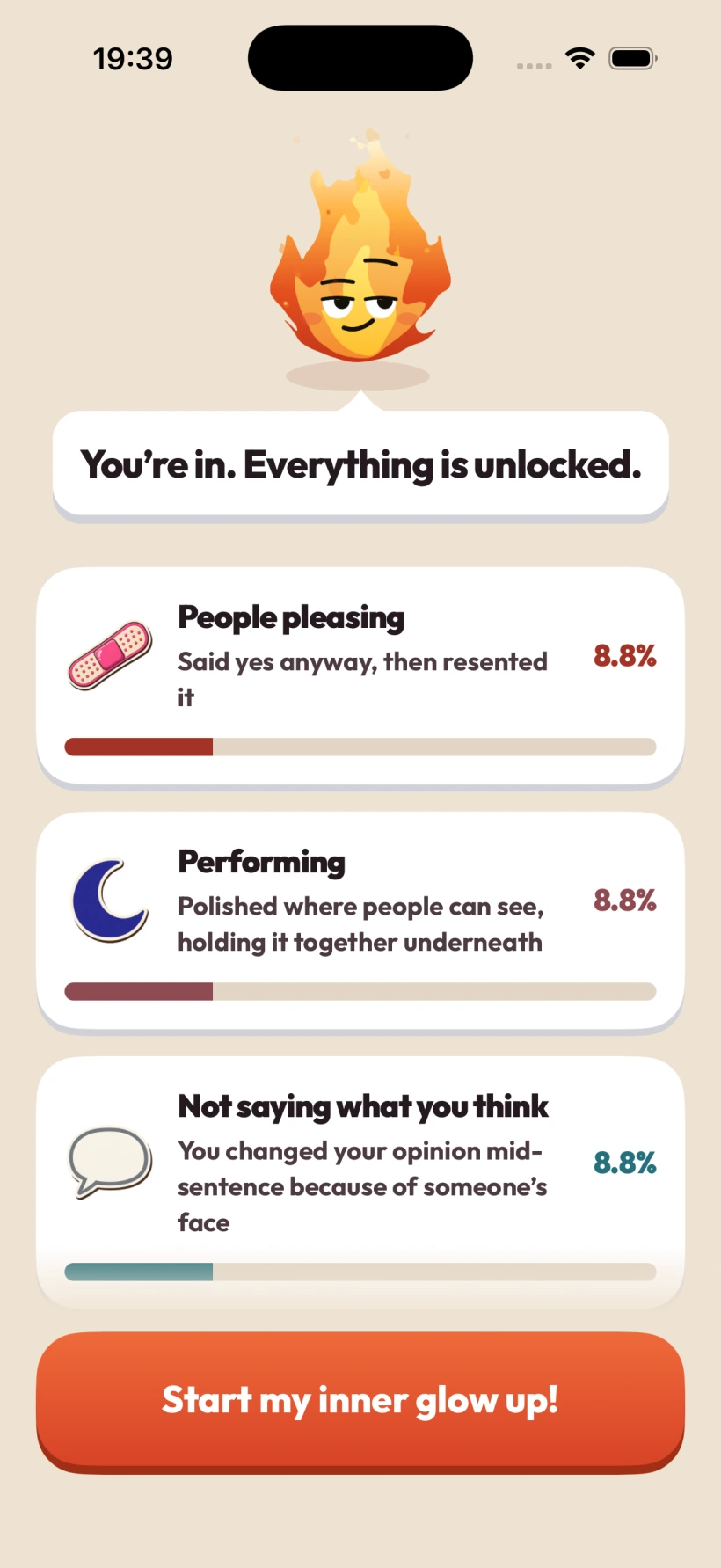
How this was compared
Questions
Is a journaling app better than a mood tracker?
They answer different questions. A journal tells you what you think, in your words, and needs ten to twenty minutes. A tracker tells you when you felt bad, in ten seconds, and cannot tell you why. On ten seconds a day the tracker wins, because a journal you do not open is worth nothing.
What is a shadow work journal?
A prompted journal aimed at the parts of yourself you avoid looking at: the resentment, the envy, the thing you have told nobody. The prompts are the product. It is a real format with real value, it asks a lot on a bad night, and it is not clinical.
Can an app change a habit like people pleasing?
An app cannot say your no for you. It can decide the sentence in advance, put it in front of you when it is needed, and keep the count afterwards. Deciding the exact move in advance is the most reliable result in behaviour change research. The count matters because memory keeps the one time it went badly and drops the eleven times it did not.
Which of these is free?
I Can Say No is free with ads and works offline. Wysa is free to talk to and needs no sign-up. Most journal apps have a usable free tier. Glissa is $59.99 a year, which works out at $4.99 a month, and the test with your first number comes before any charge.
This compares formats rather than treatments, and none of it is clinical advice. If you are in a crisis, look for the numbers your country lists for immediate help.

Find out which pattern is taking the most from you.
Two minutes, and you know which part to take back first.
Keep reading
All of it →How to stop being a people pleaser
Seven steps in the order that works, and the one that does most of the lifting.
9 min readHow much of you is showing?
One number, and the four patterns taking the rest of you.
2 minutesThe other patterns have their own tests
Anxious attachment, pushing people away, losing yourself. Ninety seconds each.
All the quizzes